

Most discussion around AI infrastructure still centres on hyperscalers. That framing is becoming increasingly incomplete.
Alongside them, a new class of operator is emerging. Less visible, but moving quickly. These are not general-purpose cloud platforms built for everything. They are purpose-built environments designed specifically for AI workloads. The term “neocloud” has started to surface to describe them, but the shift is more important than the label.
This is not about replacing hyperscalers. It is about the market fragmenting and specialising as AI moves from experimentation into production.
Neoclouds are shaped by a very different set of priorities. They are built around GPUs rather than general compute. They are designed for rapid deployment rather than long planning cycles. They operate with a level of commercial and technical flexibility that reflects the pace at which AI companies are developing products.
Many are venture-backed. They behave more like product companies than infrastructure providers. Capacity is brought online quickly, expanded quickly, and iterated on continuously.
Hyperscalers remain essential. Their scale and global platforms are unmatched. But they are not optimised for every use case. Neoclouds exist because AI companies increasingly need environments that can be deployed, adapted and scaled at speed.
AI is not just being consumed differently. It is being built and delivered differently.
As workloads evolve, so too does the role of infrastructure.
AI environments are becoming more akin to production systems than traditional IT estates. The term “AI factory” has begun to capture this shift. It describes infrastructure designed for continuous output. Model training, inference and iteration happening at pace, with high utilisation of specialised hardware.
This is a departure from how data centres have historically been used. Infrastructure is no longer passive. It is directly tied to revenue generation and product development cycles.
In that context, efficiency is not simply about uptime. It is about throughput. How quickly models can be trained, deployed and improved.
The requirements that follow are challenging many long-held assumptions.
Deployment timelines are compressing. Capacity is expected in months, not years. GPU density is rising well beyond what many facilities were originally designed to support. Clients are building ahead of demand, not in response to it, which places a premium on having capacity available and ready to scale.
Traditional data centre models have tended to optimise for stability and predictable utilisation. That does not align neatly with AI businesses, where growth can be uneven and rapid.
In this environment, being slightly late is often enough to miss the opportunity entirely.
Despite the global nature of AI development, location continues to play a critical role.
The UK is unlikely to become a centre for large-scale AI training without significant structural change, particularly around power. But that does not diminish its importance. London remains a key location for inference, enterprise deployment and access to high-value data sets across finance, healthcare and government.
AI is not only trained. It is applied, integrated and consumed close to users and systems. That keeps major metropolitan areas highly relevant.
The gap between demand and readiness is becoming more visible.
Neocloud operators require environments that can support high-density GPU infrastructure, with flexibility around cooling and configuration. They need power secured in advance, not contingent on long lead times. They need the ability to deploy quickly and expand without friction. And they need a partner that can operate alongside them, not simply provide space and power.
Many traditional facilities struggle to meet these requirements. They were designed around different workloads, different densities and different commercial assumptions. Retrofitting for AI is not always straightforward.
The constraint is no longer demand. It is the ability to deliver infrastructure that matches how these businesses operate.
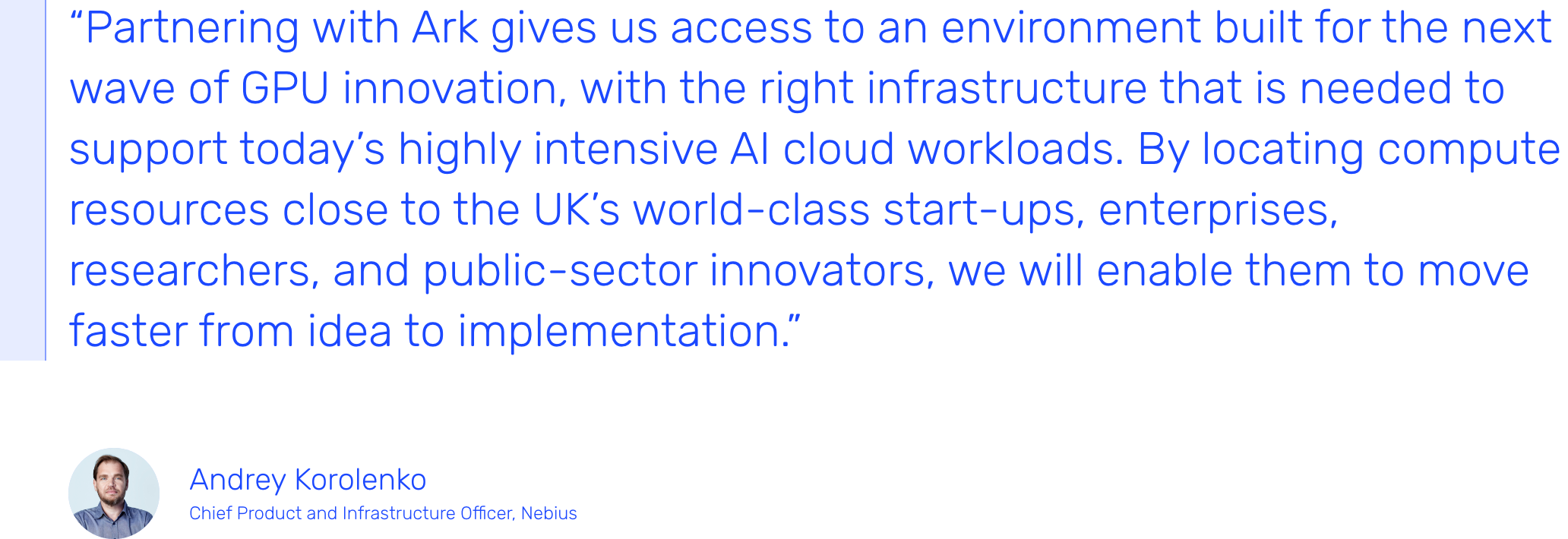
The recent deployment with Nebius illustrates how expectations have shifted.
As a neocloud operator, Nebius required infrastructure that could be delivered rapidly, support high-performance GPU environments and remain resilient under load. The emphasis was not just on capacity, but on how quickly that capacity could be made operational.
A member of the Nebius team described it simply:
“Speed is fundamental for us. We need to bring capacity online quickly, without compromising performance or reliability. That requires a partner who understands the operational demands of AI infrastructure and can deliver against them.”
Delivering that outcome depends on more than design. It requires alignment between teams, clear execution and the ability to remove friction at every stage of deployment.
Neoclouds are not a short-term response to AI demand. They reflect a deeper shift in how infrastructure is used and valued.
Hyperscalers will continue to play a central role. But they will increasingly sit alongside a more diverse ecosystem of operators, each optimised for different parts of the AI lifecycle.
Speed, density and adaptability are becoming as important as scale. Infrastructure is no longer a background utility. It is an active component of competitive advantage.
The next phase of AI will not be defined solely by who builds the largest models, but by who can deploy, iterate and scale them most effectively. That places infrastructure at the centre of the equation.



.svg)

